Product design

Product design

Mobile IA

Mobile IA

A/B testing

A/B testing

Copy Trading
Trader Discovery Redesign

Copy Trading
Trader Discovery Redesign

I redesigned the mobile Copy Trading discovery flow, turning ranking categories into direct entry points for comparing traders.

The new flow carried each user's chosen standard into All Traders and increased Copy conversion by 21.4% in an A/B test.

I redesigned the mobile Copy Trading discovery flow, turning ranking categories into direct entry points for comparing traders.

The new flow carried each user’s chosen standard into All Traders and increased Copy conversion by 21.4% in an A/B test.

Role

Product Designer

Product Designer

Team

1 PM · 1 Designer ·

12 Engineers

1 PM · 1 Designer ·

12 Engineers

Result

+21.4% Copy conversion

+21.4% Copy conversion

Duration

2026.04-2026.05

2026.04-2026.05

Context

Context

Users were choosing who to trust.

Users were choosing who to trust.

Copy Trading starts with one question: who should I copy?


Users evaluated traders through different signals — ROI, drawdown, money earned, or recent performance — but the old flow scattered those signals across separate ranking modules.

Old flow

Old flow

Split one decision across three places.

Split one decision across three places.

After entering Copy Trading, users saw two first-level tabs: Leaderboard and All Traders.


Leaderboard showed four ranking modules. Each module exposed a few traders and a More entry. More opened Rankings, a full ranking page with four ranking tabs. From Rankings, View More Traders sent users back to All Traders.


All Traders was the full trader list. Search, filters, trader cards, and Copy all lived there.

After entering Copy Trading, users saw two first-level tabs: Leaderboard and All Traders.


Leaderboard showed four ranking modules. Each module exposed a few traders and a More entry. More opened Rankings, a full ranking page with four ranking tabs. From Rankings, View More Traders sent users back to All Traders.


All Traders was the full trader list. Search, filters, trader cards, and Copy all lived there.

Problem

Problem

Ranking categories were doing page work

Ranking categories were doing page work

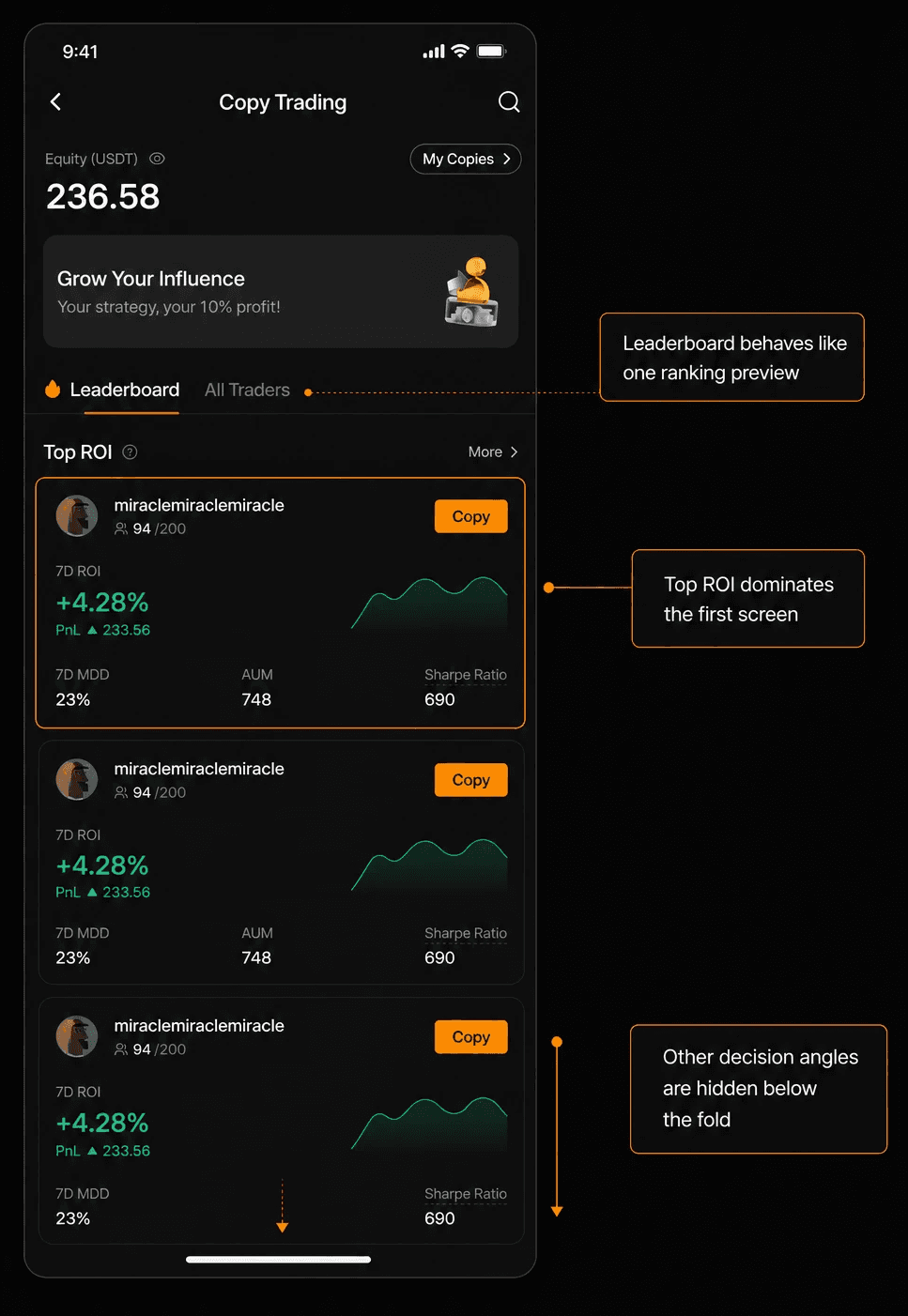
Leaderboard had four useful ways to start choosing a trader. In the old flow, those angles lived inside a vertical stack and a separate Rankings page. The first screen mostly showed Top ROI, so users got a narrow first read of the product: return ranking.

Leaderboard had four useful ways to start choosing a trader. In the old flow, those angles lived inside a vertical stack and a separate Rankings page. The first screen mostly showed Top ROI, so users got a narrow first read of the product: return ranking.

Problem · 01

Leaderboard underplayed discovery

Leaderboard underplayed discovery

The four rankings represented four ways to choose a trader. On the first screen, users mostly saw Top ROI. Risk, copiers' profit, and new-trader potential appeared later in the scroll.
Problem · 02

Extra middle layer

Extra middle layer

More led from Leaderboard to Rankings, then View More Traders led users back to All Traders.

Research

Research

How ranking modules lead into full lists.

How ranking modules lead into full lists.

I reviewed six competitors with one question in mind: when a product has both ranking recommendations and a complete trader list, what happens after a user taps View More? I looked for whether the next step preserved the user's current standard, like high ROI or lower drawdown, or sent them into another standalone ranking page.

I reviewed six competitors with one question in mind: when a product has both ranking recommendations and a complete trader list, what happens after a user taps View More? I looked for whether the next step preserved the user’s current standard, like high ROI or lower drawdown, or sent them into another standalone ranking page.

Solution

Flatten the route and make Recommend do real discovery.

Flatten the route and make Recommend do real discovery.

I changed the structure in four places: the top-level tabs, the View More handoff, the Recommend page, and the trader cards inside each ranking.

I changed the structure in four places: the top-level tabs, the View More handoff, the Recommend page, and the trader cards inside each ranking.

Solution · 01

Reset the top-level model around user situations

Reset the top-level model around user situations

Leaderboard and All Traders described product surfaces. I changed the model to the moments users were in: finding a direction, comparing a larger set, or returning to traders they were watching. That became Recommend, All Traders, and Favorites.

Solution · 02

Make Recommend work as a discovery surface

Make Recommend work as a discovery surface

Instead of stacking ranking modules top to bottom, Recommend now surfaces the four decision angles earlier: high return, lower risk, copiers' profit, and new talent. Featured Picks gives users a quick orientation layer, while the ranking modules below offer more evidence when users want to keep browsing.

Solution · 03

"View All" carries each ranking's metric into All Traders

“View All” carries each ranking’s metric into All Traders

Each ranking category acts as an entry state: Top ROI opens the list already sorted by ROI, Low Risk enters around drawdown and stability, and Copiers' PnL keeps the focus on copier-side profit.

This keeps the path continuous — from spotting a recommended direction to browsing more of the same.

Solution · 04

Match each card's data to its ranking goal

Match each card’s data to its ranking goal

The old ranking cards used similar trader information across sections. I kept the data that explains the reason behind each ranking: ROI cards focus on recent return, Steady Earners focus on MDD and win rate, Copiers' Top PnL focuses on copier-side profit, and New Talents focuses on recent momentum.

Measure

Measure

The redesign increased Copy conversion by

21.4%

21.4%

We rolled the new flow out to a portion of users and ran an A/B test against the old experience. Copy conversion was the primary metric, because the redesign focused on the path from discovering a trader to taking action.


Beyond that headline number, the supporting signals moved the same way.

More users clicked into Recommend entries, kept browsing after View All opened All Traders, and came back to traders they'd saved to Favorites.

We rolled the new flow out to a portion of users and ran an A/B test against the old experience. Copy conversion was the primary metric, because the redesign focused on the path from discovering a trader to taking action.


Beyond that headline number, the supporting signals moved the same way.

More users clicked into Recommend entries, kept browsing after View All opened All Traders, and came back to traders they’d saved to Favorites.